
 Healthcare Professionals



About Urinary Tract Infections
If you think you might have a Urinary Tract Infection, you’re not alone.
What is a
urinary tract infection?
A urinary tract infection is an infection involving the urinary system, made up of your kidneys, ureters, bladder and urethra.
These are the structures that urine passes through before being eliminated from the body. Urinary tract infections are caused by bacteria developing in your urinary tract. The infection may cause pelvic pain, increased urge to urinate or pain while urinating. UTIs that are limited to the bladder can be painful and an inconvenience but are very common and typically go away within a couple of days of proper treatment in otherwise healthy individuals. A UTI can become more serious if it goes untreated and spreads to the kidneys.
Did you know?
At least 30% of women experience a second UTI within six months of their first.*
More information
 Know Your Urine
 UTI FAQs
What causes a UTI?
Urinary tract infections (UTIs) typically occur when bacteria enter the urinary tract through the urethra and begin to multiply in the bladder.
Although the urinary system is designed to keep out such microscopic invaders, these defenses sometimes fail. When that happens, bacteria may take hold and grow into a full-blown infection in the urinary tract. The most common UTIs occur mainly in women and affect the bladder and urethra.

Infection of the bladder (cystitis)
This type of UTI is usually caused by Escherichia coli (E. coli), a type of bacteria commonly found in the gastrointestinal (GI) tract. However, sometimes other bacteria are responsible. Sexual intercourse may lead to cystitis, but you don’t have to be sexually active to develop it. All women are at risk of cystitis because of their anatomy – specifically, the short distance from the urethra to the anus and the urethral opening to the bladder.
Infection of the urethra (urethritis)
This type of UTI can occur when GI bacteria spread from the anus to the urethra. Also, because the female urethra is close to the vagina, sexually transmitted infections, such as herpes, gonorrhea, chlamydia and mycoplasma, can cause urethritis.
More information
 UTIs
UTIs  UTI Myth vs Fact
Source: http://www.mayoclinic.org/diseases-conditions/urinary-tract-infection/basics/causes/con-20037892
Treating UTIs
Antibiotics from your doctor are the only cure for urinary tract infections..
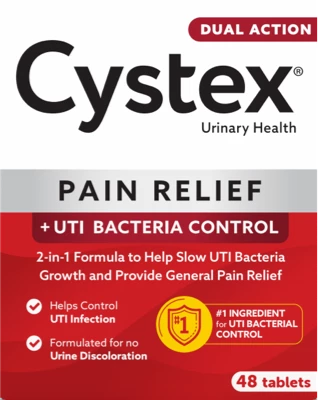
Which specific antibiotics are prescribed and for how long depend on your health condition and the type of bacteria found in your urine. Cystex can help get you through the pain of a UTI while you wait for your doctor’s appointment. Cystex Pain Relief & UTI Bacteria Control Tablets is a unique over-the-counter medication with a dual-action formula that combines pain relief with an antibacterial to help slow the progression of the infection.
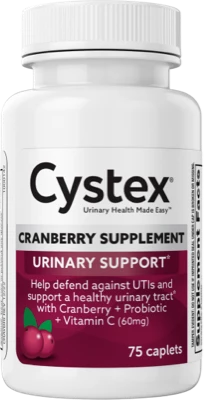
After treating your UTI, consider adding Cystex Urinary Health Maintenance to your daily routine. Just one tablespoon is loaded with powerhouse ingredients that can benefit urinary health.*

More information
 UTI
UTI *These statements have not been evaluated by the Food and Drug Administration. These products are not intended to diagnose, treat, cure or prevent any disease.
1. Study in healthy women with ≥2 episodes of simple UTI in the last 6 months, or ≥3 episodes of simple UTI in the last 12 months